

Supply Meets Demand
If demand goes up, everyone wants it, the price goes up. If supply goes up, too much of it, the price goes down.
That is economics. Supply is how much of something is available. Demand is how much people want it. But the thought I kept sitting with was, what happens when we start applying that same language to love, relationships, attention, money, status, and the way Black men and Black women interact with each other?
This Anonymous Plugs shoot started as a conversation between art, culture, and the way we see relationships today. I was inspired by American Gothic, the 1930 painting by Grant Wood. In the original painting, Wood shows a farmer and his daughter standing in front of a home, though over time a lot of people have read them as a husband and wife because of the way the image lives in American culture. What caught my attention was not just the two people standing there, but what they represented: land, work, home, duty, and a foundation.
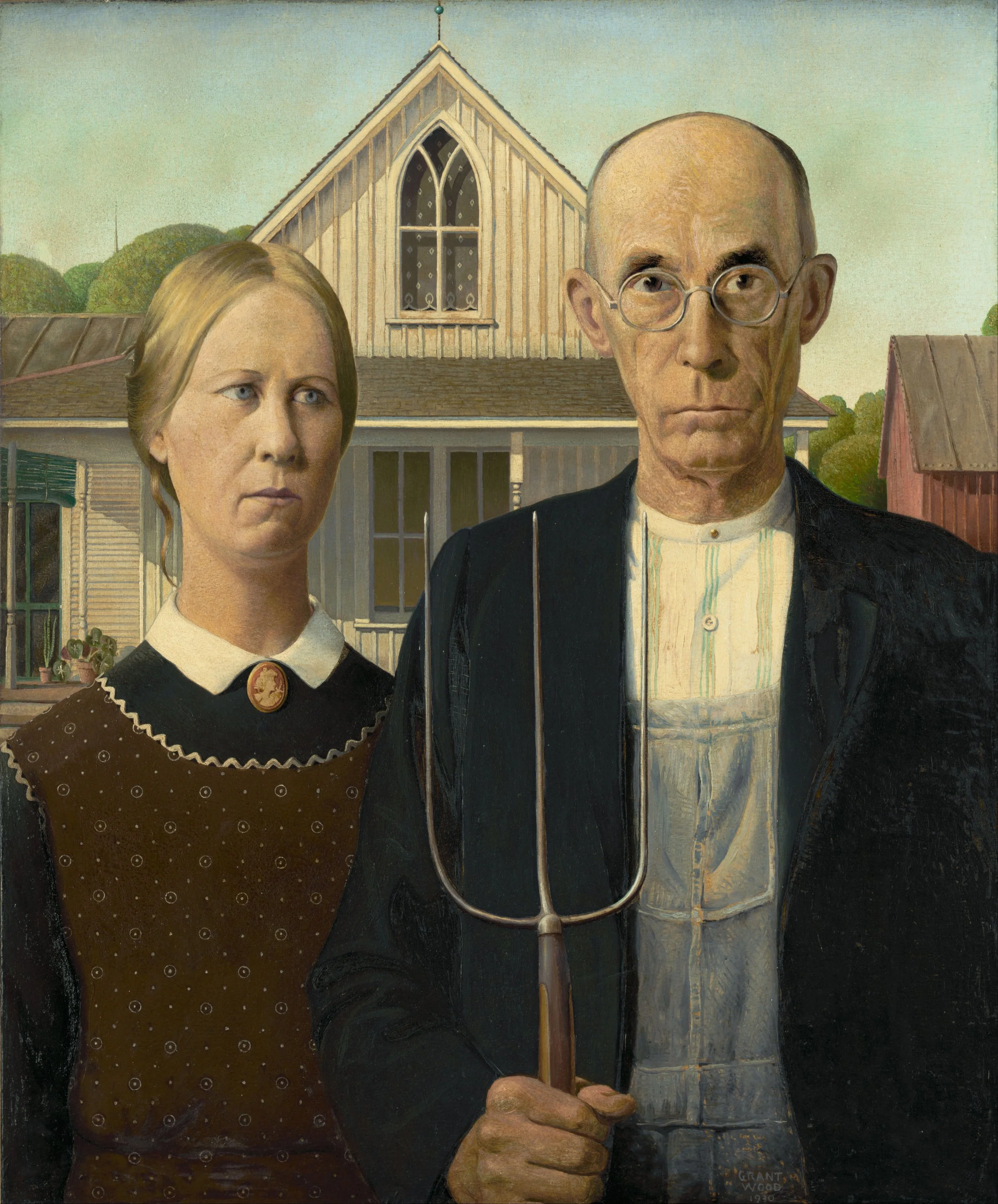
American Gothic (1930) by American Regionalist artist Grant Wood
The painting represents rural Midwestern American life and values during the Great Depression.
When I looked at that painting, I thought about farming as its own form of economics. You plant, you wait, you work, you harvest, and then you supply. But the supply is not just for yourself. It feeds a household. It feeds children. It feeds a community. That is what made me want to recreate the image through an urban and culturally significant lens, using the durag as the center of the message.
In my version, one durag says “Supply” and the other says “Demand.” The couple is standing side by side, but the question is not just who is supplying and who is demanding. The real question is, what are we building together? Are we supplying something that feeds our community, or are we demanding from each other in a way that only feeds the ego?

Supply Meets Demand
〰️
(2025)
〰️
By Anonymous Plugs
〰️
Supply Meets Demand 〰️ (2025) 〰️ By Anonymous Plugs 〰️
There is also another art reference in the shoot. The slight mesh in front of the models’ faces is a direct nod to René Magritte’s The Lovers from 1928. In that painting, two figures are close together, but their faces are covered in cloth. MoMA describes the fabric as a barrier that turns an intimate embrace into something isolated and frustrated, and that is exactly what stood out to me.

René Magritte’s The Lovers from 1928
The Lovers depicts a passionate embrace between two figures whose heads are shrouded in white fabric. The cloth obscures their faces, turning an act of intimacy into a haunting display of isolation, mystery, and blocked communication.
When I saw The Lovers, I thought about how two people can be close but still not truly see each other. It made me think of the phrase “the blind leading the blind,” because sometimes that is what relationships feel like today. Two people both wanting love, both wanting security, both wanting to be chosen, but both moving through the same fog because the culture around them has trained them to value the wrong things first.
That is why I put a sheer mesh cloth in front of my models’ faces. It is meant to represent the way we are blinded by the construct of transactional love. It is not a solid wall, though. It is mesh. You can still see through it if you focus. That detail matters because I do not believe we are completely lost. I think we are distracted. I think we are looking through the wrong lens. If we focus hard enough, we can see each other again.
Modern day urban culture has conditioned us to play roles that nobody really assigned, but somehow everybody seems to follow. Men are told to be the supplier of money, attention, status, lifestyle, and proof. Women are told to demand those things before anything deeper is even understood. Before we know somebody’s spirit, discipline, values, family goals, or intentions, the interaction can already start to feel like a negotiation.
From the female point of view, it can become, “You have money, I want it.” From the male point of view, it can become, “You want money, I can supply that, but with tax, if you know what I mean.” That is where the dynamic between Black men and Black women can become transactional before it ever reaches the stage of creating a family the right way.
And I am not saying this to blame one side. I think both sides have been conditioned. Both sides are reacting to what they have seen, what they have been taught, what they have survived, and what the culture keeps rewarding. But at some point, we have to ask if we are relating to each other or simply exchanging with each other.
That is what made me think about the past. Not because I believe the 1950s were perfect, because they were not. Black people were dealing with racism, segregation, discrimination, and a world that was constantly trying to limit them. So when I bring up that time, I am not romanticizing the pain of it. I am asking a real question: if Black people were dealing with so much adversity, why did it still seem like there was more unity in certain homes and communities?
I understand that a home does not always mean perfect. A mother and father being present does not automatically mean peace. Marriage does not automatically mean love. But there seemed to be a stronger sense of responsibility, and that is the part I keep thinking about. Family was not just about romance. It was about survival, legacy, protection, and community. People understood that what they did affected more than just themselves.
Maybe the hardship created a certain kind of drive. When the outside world gave Black people so little room, they had to become something for each other. They had to create pride where they were denied respect. They had to create structure where systems tried to create instability. They had to create their own care, their own beauty, their own dignity, and their own ways of making a home feel like protection.
That does not mean every family was healthy. It does not mean every relationship was equal. It does not mean we should copy everything from the past. But it does make me wonder what we have lost in the middle of gaining more access, more visibility, more platforms, and more ways to be seen. We have more ways to connect now, but are we more connected? We have more ways to be desired, but are we more loved? We have more ways to make money, but are we building anything that lasts?
This is where supply and demand becomes more than a business term. In farming, supply meant labor with purpose. It meant producing something that could feed people. But in modern dating culture, supply can turn into performance. A man supplying money does not always mean he is building, and a woman demanding money does not always mean she is being valued. Sometimes it is just a transaction dressed up as romance.
Money matters. Bills are real. Security is real. Survival is real. Nobody is saying money does not matter. But money was never supposed to replace humanity. The love of money has become one of the things standing in the way of our growth as a community, because it has started to measure things it was never meant to measure: masculinity, femininity, beauty, power, worth, and commitment.
A man giving money does not always mean love. A woman accepting money does not always mean value. A man providing does not mean ownership. A woman wanting security does not mean she should sell herself short. There is a difference between provision and transaction, between generosity and control, between courtship and using somebody. I think most of us know the difference, but the culture has made it easy to ignore.
We need to become more relational again. Relational means prioritizing real, deep human connections over business exchanges. It means seeing someone as a full person before seeing them as a benefit. Humanizing means seeing a person’s full depth, feelings, and soul. We must learn to see each other through a holistic lens, because when you only see a man as what he can supply, you miss who he is. And when you only see a woman as what she can give in return, you miss who she is.
To my ladies, that $100 from a man you met last week to get your nails done might feel good in the moment, but if you have no intention of exploring anything serious, and you do not respect him beyond what he can send you, what are you really building? I am not saying that from judgment. I am saying it because quick money can quietly train us to keep looking for the next temporary fix instead of a real foundation.
And fellas, if you are giving a woman $100 for her hair, nails, or outfit, but you barely know her and you are only doing it because you expect something quick in return, then you are also participating in the same broken exchange. Paying for access is not the same thing as building with someone. Investing in the right person can build family, peace, emotional intelligence, generational wealth, and legacy. But when there is no integrity behind the giving, it is not provision. It is just a receipt.
That is the part we have to be honest about. Supply and demand might work in business, but it cannot build a home by itself. It cannot raise children with values. It cannot heal the distance between Black men and Black women. It cannot give our community the kind of foundation it needs if we keep treating each other like products, prizes, ATMs, bodies, favors, or status symbols.
So when I ask myself why certain communities seemed stronger under harder conditions, the conclusion I keep coming back to is self-respect. Respect on both ends. Respect for oneself, respect for the home, respect for the family, respect for the future, and respect for the person standing in front of you. Not because we need to be perfect, but because we need to remember that our choices affect more than the moment.
That is what I feel we are lacking today. Not style, not talent, not influence, not money, because we have plenty of that. What we need more of is humility, dignity, poise, and the ability to see each other clearly again. We do not have to look too far. The mesh is thin. The vision is still there. We just have to focus long enough to see through the fog.
That is what this Anonymous Plugs shoot represents to me. The durag has always been deeper than what people tried to reduce it to. It is culture, memory, identity, protection, beauty, and Blackness. So when I use the durag in my work, I am not just styling fabric. I am opening a conversation about who we are, how we love, how we see each other, and what kind of foundation we are trying to build.
Because the question is not only what do you demand, or what can someone supply. The better question is, what can we build together that feeds more than our ego? What can we create that strengthens the home, the family, and the community?
Supply meets demand.
But love should meet dignity, purpose, integrity, and self-respect. Maybe that is where we start seeing each other clearly again.