
Golden Reclamation: The Roots of Nubia and Sudan



The Story Behind the Photo Series: Part I
When people talk about the ancient world, Egypt is almost always placed at the center of the conversation. We hear about the Egyptian pyramids, the mummies, the pharaohs, the gold, the monuments, and the civilization built along the Nile.
But the Nile does not begin and end in Egypt.
Sudan is part of that story too.
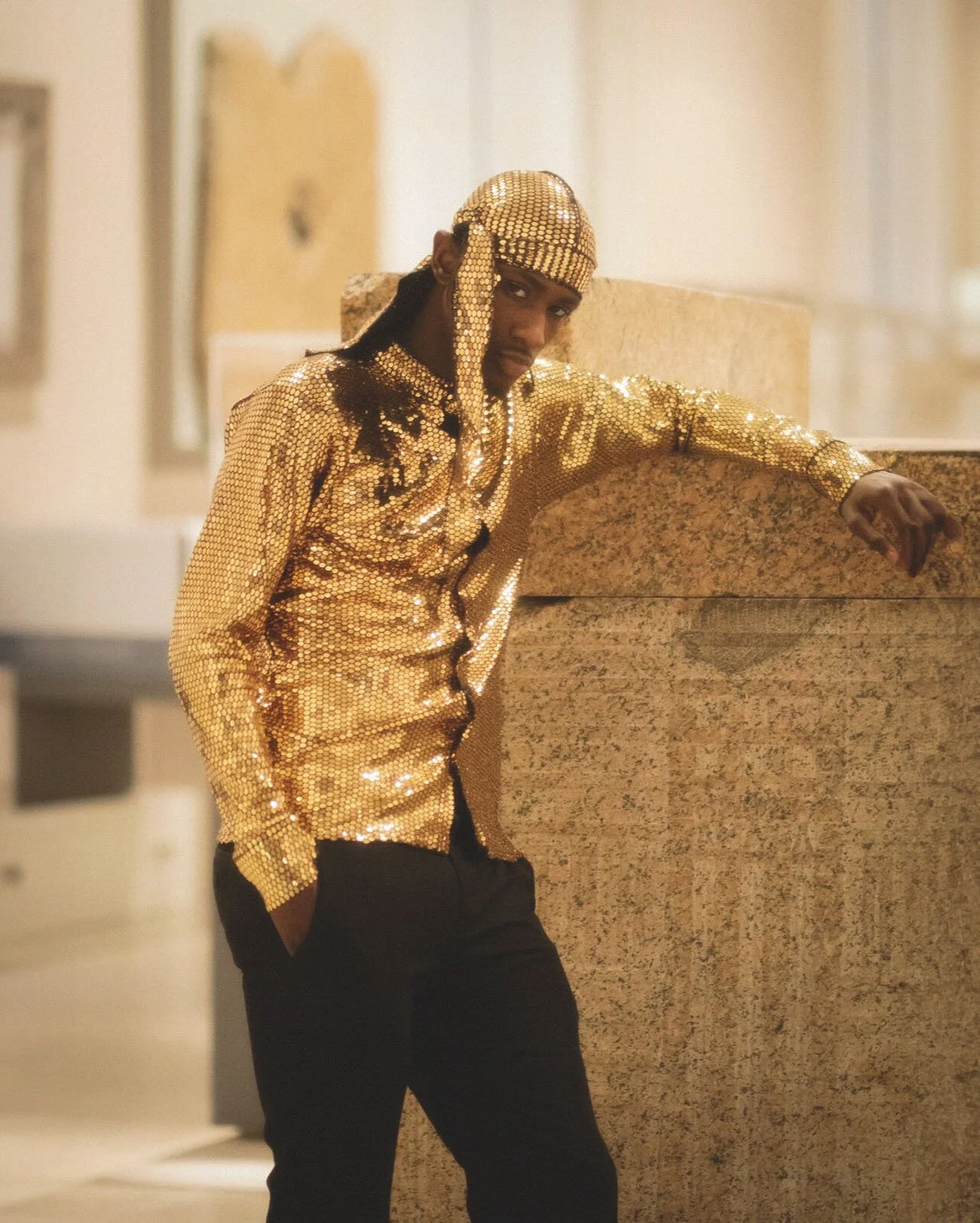
That is the foundation of Golden Reclamation, a photo series featuring a young Sudanese boy dressed in a full gold suit and matching durag. Through him, I wanted to explore the history of Nubia, the relationship between Sudan and Egypt, and what it means to reclaim a legacy that the world rarely teaches in full.
The Part of the Story We Rarely Hear
Sudan is home to more surviving ancient pyramids than Egypt, yet that fact still surprises many people. Across sites such as Meroë, Nuri, El-Kurru, and Jebel Barkal stand the remains of pyramids, temples, royal burial grounds, and cities built by the civilizations of ancient Sudan.
Why are these places not discussed with the same recognition?
Why do we grow up knowing the names of Egypt’s pharaohs while rarely hearing about the kings and queens of Kush?
Why is Egypt presented as the complete story when Sudan played such an important role in the history of the Nile Valley?
This series begins with those questions.
It is not about taking anything away from Egypt or denying the greatness of ancient Egyptian civilization. It is about widening the frame. There is more to this history than the version most of us were given, and Sudan cannot remain invisible inside a story it helped shape.
One Nubian Region Across a Modern Border
Today, we understand Egypt and Sudan as two separate countries. But the modern border does not fully explain the ancient world.
Nubia was a region along the Nile that extended through what is now southern Egypt and northern Sudan. The Nubian people, cultures, and civilizations existed across both sides of the border we recognize today.
That is the part I was trying to express when I originally described the two places as once being one. I was speaking about Nubia—a historical and cultural region that connected northern Sudan and southern Egypt long before the modern countries and their borders existed.
Egypt and the different Nubian kingdoms were not always one government or one civilization. They had their own identities and systems of power. At different times, they traded with one another, fought one another, influenced one another, and ruled territories belonging to one another.
But their histories cannot be completely separated.
They shared the Nile. They exchanged architecture, religion, art, symbols, resources, and royal traditions. Their cultural relationship was closer and more intertwined than the simplified history most people are taught.
Sudan was not simply standing beside greatness.
Sudan was part of the greatness of the Nile Valley.
When Kush Ruled Egypt
One of the most important parts of this history is the rise of the Kingdom of Kush, centered in what is now Sudan.
During the Twenty-Fifth Dynasty, Kushite rulers from Nubia governed Egypt and became pharaohs. Kings including Piye, Shabaka, Shebitku, Taharqa, and Tantamani ruled within a political and cultural world that connected Kush and Egypt.
This was not Sudan merely observing Egyptian history from a distance. These were rulers from Kush participating directly in the history of Egypt while carrying their own Nubian identity, power, and traditions.
Their monuments and royal burials remain part of the physical landscape of Sudan. Their history lives in places such as Napata, Meroë, Nuri, El-Kurru, and Jebel Barkal.
Yet their names are rarely given the same attention as other pharaohs.
That absence is exactly why reclamation matters.
The Boy in Gold
The boy in these photographs is Sudanese. That detail is essential to the meaning of the series.
He is not dressed in gold simply because gold looks luxurious. Gold represents royalty, value, power, inheritance, and the wealth associated with the ancient Nile Valley. Nubia was also historically known for its gold, which played an important role in its relationship with Egypt.
But in these images, gold represents something even deeper.
It represents a history that was never worthless—only undervalued.
The boy stands among images of ancient rulers, burial monuments, and preserved history as someone connected to that inheritance. He is not looking at the past as though it belongs to strangers. His presence brings Sudan back into a visual conversation from which it is too often excluded.
He is young because this history must reach a new generation.
He is Sudanese because Sudan belongs in the story.
He is covered in gold because what he carries is valuable.
The Durag and the Nemes
The shape and movement of the durag also create a visual connection to the nemes, the striped royal headcloth associated with ancient pharaohs.
The durag is not being presented as the same object as the nemes, nor am I claiming that one directly descended from the other. The connection in this work is visual and symbolic.
Both pieces frame the head. Both create a strong silhouette. Both can extend behind the wearer and transform the way the body is seen. Within the imagery of this series, the durag echoes the presence of a royal headcloth while remaining completely rooted in its own Black cultural meaning.
The nemes is most widely associated with Egyptian pharaohs, but Kushite rulers also entered that tradition of pharaonic kingship when they ruled Egypt during the Twenty-Fifth Dynasty. Representations of Kushite pharaohs combined elements of Egyptian royal imagery with symbols of Kushite identity.
That shared royal language makes the comparison important to this particular story.
The durag becomes a contemporary crown.
It connects a modern Sudanese child to the image of the ancient ruler—not by pretending that the two objects are historically identical, but by allowing one powerful symbol of Black identity to speak to another.
Reclaiming History Through Movement
In one photograph, the boy stands quietly before an ancient figure. In another, he swings the long tail of his golden durag through the air.
That movement changes the energy of the story.
He is not frozen inside history. He is alive within it.
There is joy, freedom, youth, and confidence in the way the durag moves. The ancient setting may represent what came before him, but the boy represents what continues.
History is not only found inside pyramids, tombs, museums, and monuments. It lives in the people who inherit it. It lives in our faces, our traditions, our creativity, our clothing, and the stories we choose to tell.
The past is not a dead object.
It moves with us.
Widening the Frame
Golden Reclamation does not ask the world to stop celebrating Egypt. It asks why Sudan has not been celebrated alongside it.
You cannot speak about the history of the Nile Valley without speaking about Nubia. You cannot speak about Nubia without acknowledging both Sudan and Egypt. And you cannot discuss the pharaohs without remembering that, for a significant period, Kushite rulers from ancient Sudan wore the crowns of Egypt too.
The story is larger than one modern country.
It is a history connected by the Nile, shaped by neighboring civilizations, and carried by people whose identities still cross the borders drawn much later.
Sudan holds pyramids, royal cities, temples, burial grounds, mummies, monuments, and the history of powerful African kingdoms. It should not be treated as a footnote to Egypt’s story.
It deserves to be seen.
The Sudanese boy in these photographs is not asking permission to enter the history.
He is showing us that he was already part of it.
That is the reclamation.
That is why he wears gold.
Historical Grounding
The historical foundation of this Journal entry draws from the preservation and interpretation of Nubian heritage by the Sudan National Museum, Sudanese archaeologists and historians, the National Corporation for Antiquities and Museums in Sudan, and the Nubian Museum in Aswan, Egypt.
These institutions and scholars preserve a history that existed before today’s borders. Their work recognizes Nubia as a cultural and historical region extending through present-day northern Sudan and southern Egypt, while also recognizing the Kingdom of Kush—centered in ancient Sudan—as a powerful civilization with its own rulers, cities, monuments, pyramids, religious traditions, and political influence.
Golden Reclamation is an artistic interpretation of that history from the perspective of Sudanese artist Khalida Ali. The visual relationship drawn between the modern durag and the ancient nemes is symbolic and is not intended to claim that the two garments are historically identical or that one directly descended from the other.